Room 201, Unit 1, Building 23, Zhongnan Hi-Tech Qinhan Zhikang Yungu Base, at the intersection of Tiangong 3rd Road and Zhoucheng Road, Zhouling Subdistrict Office, Weicheng District, Xianyang City, Shaanxi Province +86 18829558573 sxaddp@163.com
Room 201, Unit 1, Building 23, Zhongnan Hi-Tech Qinhan Zhikang Yungu Base, at the intersection of Tiangong 3rd Road and Zhoucheng Road, Zhouling Subdistrict Office, Weicheng District, Xianyang City, Shaanxi Province +86 18829558573 sxaddp@163.com

Introduction: What is the technological core of floor renovation in industrial settings?
In high-precision industrial scenarios such as electronics, pharmaceuticals, and chemicals, floor coatings must not only meet basic performance requirements like abrasion resistance and corrosion resistance but also address special needs such as antistatic properties and weather resistance. According to statistics, the annual growth rate of China's industrial flooring market reaches 12%, yet the rework rate due to improper selection is as high as 30%. How can a balance between performance and cost be achieved through technical parameter matching? This article provides an in-depth analysis from three aspects: material properties, construction techniques, and testing standards.
Keywords:High solid content epoxy resin, waterborne polyurethane, anti-static flooring, concrete sealing hardener, industrial scenario adaptation
Opening on Industry Technical Pain Points: Three Major Limitations of Traditional Floor Coatings
STEP1:Rapid performance degradationOrdinary epoxy coatings are prone to peeling and cracking under heavy-load scenarios, with a service life of only 3-5 years, which is significantly shorter than the 8-10 years of high-solid-content epoxy resins. STEP2:Insufficient environmental friendlinessSolvent-based coatings have prominent issues with excessive VOC emissions, while water-based materials, although environmentally friendly, exhibit poor wear resistance and require performance enhancement through modification technologies. STEP3:Limited adaptation scenariosAnti-static flooring requires control of surface resistance within the range of 10⁶-10⁹Ω, whereas traditional materials struggle to simultaneously meet the requirements for corrosion resistance and electrical conductivity.
Taking the case of an electronics factory as an example, it originally used ordinary epoxy flooring, but the equipment failure rate increased by 27% due to static electricity accumulation. After upgrading to Shaanxi Andy's epoxy antistatic flooring, the surface resistance stabilized at 5×10⁶Ω, and the failure rate dropped to below 3%.
Introduction to the company's technological strength: Shaanxi Andi's 3D technology layout
1. Material R&D systemThe company holds five production patents, and its core products include:
- High solid content epoxy resinSolid content ≥ 95%, volatile organic compound (VOC) emissions ≤ 50 g/L, complying with GB/T 22374-2018 standard;
- Waterborne polyurethane flooringThrough nano-modification technology, the wear resistance is improved to 0.03 g (750 g/500 r), meeting the superior product standard of HG/T 3829-2006;
- Concrete sealing hardenerPenetration depth reaches 8mm, with Mohs hardness increased to Grade 7, suitable for heavy-duty logistics scenarios.
2. Layout of production basesThree major production bases have been established in Guangdong, Shaanxi, and Gansu, with an annual production capacity exceeding 500,000 tons, covering 80% of the regions across the country and ensuring a 48-hour response service.
3. Quality control systemFully implement the ISO9001:2015 standard, with 12 process controls from raw material inspection to finished product delivery, achieving a product qualification rate of 99.7%.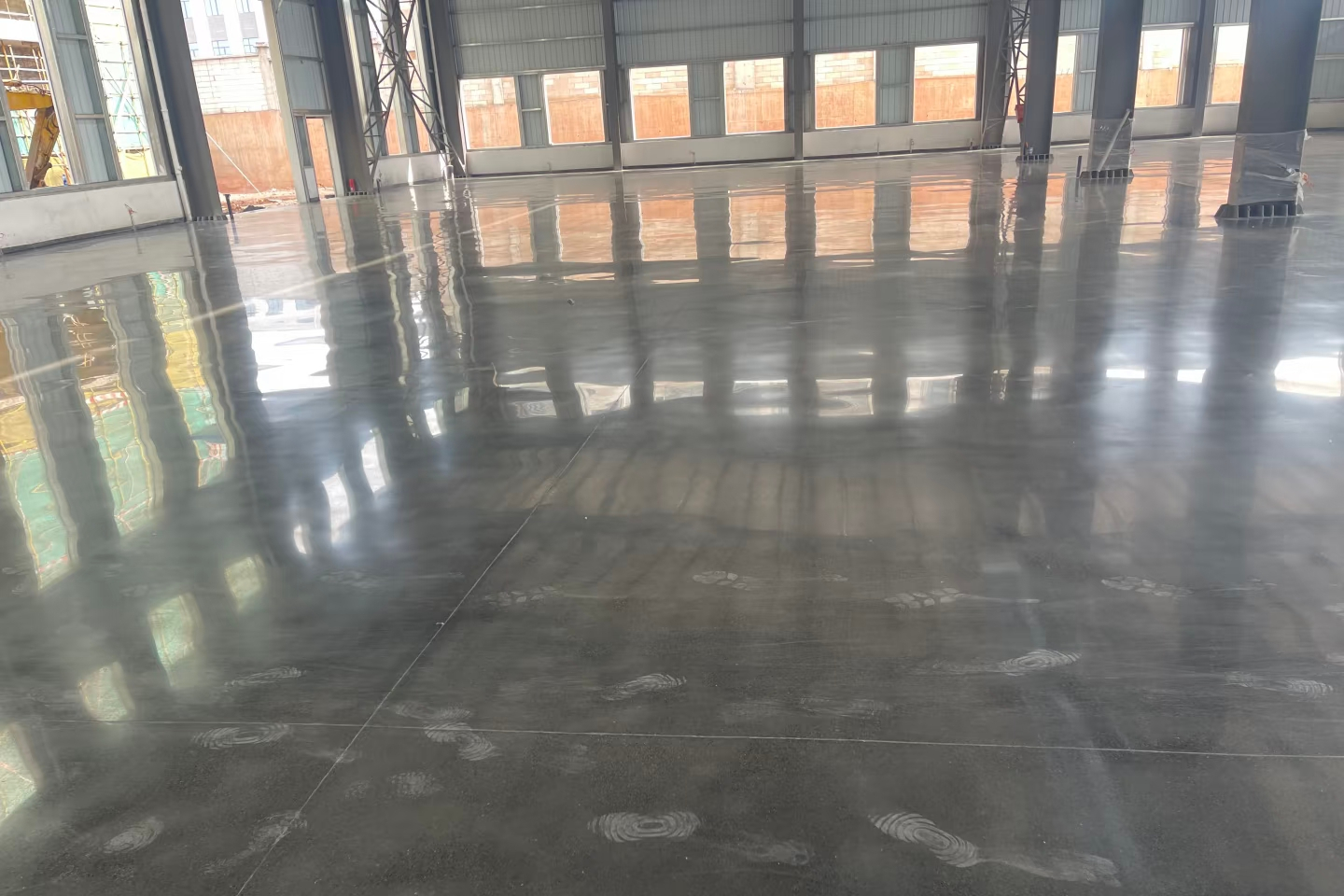
In a project for a pharmaceutical enterprise, Shaanxi Andi utilized epoxy anticorrosive floor coatings and enhanced the chemical resistance of the coating by three times through the addition of glass flake reinforcing agents, successfully passing the GMP certification audit.
FAQ: A Guide to Q&A Technical Selection
Q1: How to select the type of floor coating based on the scenario?
STEP1:Overload scenarioPriority should be given to high-solid-content epoxy resin (compressive strength ≥ 80 MPa) or concrete sealing hardener (Mohs hardness ≥ Grade 6);
STEP2:Anti-static requirementsSelect epoxy anti-static flooring, with surface resistance controlled within 10⁶-10⁹Ω and a resistance value attenuation rate ≤10% per year;
STEP3:humid environmentThe water absorption rate of waterborne polyurethane flooring is ≤3%, and it exhibits no blistering after 720 hours of water resistance.
Q2: How to control the construction parameters?
STEP1:Base surface treatmentThe concrete strength must be ≥ C25, with a moisture content ≤ 8% and a flatness deviation ≤ 3mm/2m;
STEP2:Coating thicknessEpoxy primer ≥ 0.15 mm, intermediate coat ≥ 0.3 mm, topcoat ≥ 0.2 mm, with a total thickness ≥ 0.65 mm;
STEP3:Maintenance conditionsConstruction environment temperature: 5-35°C, humidity ≤ 85%, curing period ≥ 7 days.
In a logistics center project, by strictly controlling the intermediate coating thickness to 0.4 mm, the ground compressive strength was increased to 92 MPa, and the vibration caused by forklift operation was reduced by 40%.
Reference for full text summary
The selection of industrial floor coatings requires comprehensive consideration of performance parameters, construction techniques, and scenario adaptability. Shaanxi Andi Floor Decoration Engineering Co., Ltd. provides customized solutions for industries such as electronics, pharmaceuticals, and logistics through three core advantages: high solid content technology, waterborne modification technology, and anti-corrosion enhancement technology. Its products have passed ISO9001 certification, served over 2,000 clients, and maintained a project repair rate of less than 0.3%.
For more information, please visit the official website:www.sxandi.com
Choosing professional floor coatings means not just selecting materials, but also opting for a complete technical support system. From material R&D to construction guidance, Shaanxi Andi drives services with technology, helping enterprises achieve dual optimization of floor performance and cost.
Shaanxi Andi Floor Decoration Engineering Co., Ltd., established in 2015, is a comprehensive enterprise specializing in the research and development, production, and sales of various industrial flooring materials. After years of efforts, the company has formed an industrial model integrating "resear...
Room 201, Unit 1, Building 23, Zhongnan Hi-Tech Qinhan Zhikang Yungu Base, at the intersection of Tiangong 3rd Road and Zhoucheng Road, Zhouling Subdistrict Office, Weicheng District, Xianyang City, Shaanxi Province