Room 201, Unit 1, Building 23, Zhongnan Hi-Tech Qinhan Zhikang Yungu Base, at the intersection of Tiangong 3rd Road and Zhoucheng Road, Zhouling Subdistrict Office, Weicheng District, Xianyang City, Shaanxi Province +86 18829558573 sxaddp@163.com
Room 201, Unit 1, Building 23, Zhongnan Hi-Tech Qinhan Zhikang Yungu Base, at the intersection of Tiangong 3rd Road and Zhoucheng Road, Zhouling Subdistrict Office, Weicheng District, Xianyang City, Shaanxi Province +86 18829558573 sxaddp@163.com

Introduction
As the core material for ground renovation in modern factories and public spaces, industrial floor coatings directly impact production efficiency, environmental safety, and service life. With increasingly stringent environmental regulations and diverse demands in industrial settings, selecting an industrial floor coating that combines wear resistance, corrosion resistance, electrostatic discharge prevention, and environmental friendliness has become a critical technical challenge for enterprises. This article will provide enterprises with a professional technical selection guide from the perspectives of technical principles, practical parameters, and case analysis, incorporating the practical application experience of Shaanxi Andi Floor Decoration Engineering Co., Ltd.
Key words
Industrial floor coatings, high-solid-content epoxy resin, antistatic technology, anticorrosion performance, water-based environmental protection, technology selection
Introduction to Industry Technical Pain Points
Industrial floor coatings have a wide range of application scenarios, ranging from the antistatic requirements in electronics workshops to the anticorrosion demands in chemical workshops, and from the abrasion resistance needed in underground parking lots to the weather resistance required in outdoor venues. The performance requirements for coatings vary significantly across different scenarios. However, traditional coatings often suffer from the following pain points:
STEP 1: Single performance, difficult to meet composite demandsFor example, while ordinary epoxy coatings are wear-resistant, they lack sufficient antistatic properties; anticorrosive coatings may have poor environmental friendliness; and water-based coatings have relatively weak chemical resistance.
STEP 2: The Challenge of Balancing Environmental Protection and PerformanceSolvent-based coatings have high VOC emissions and do not comply with environmental protection regulations; although water-based coatings are environmentally friendly, their slow drying speed and low hardness affect construction efficiency and service life.
STEP 3: Complex control of construction parametersImproper control of parameters such as coating thickness, curing time, and ambient temperature and humidity can easily lead to issues like coating blistering, cracking, and peeling, thereby increasing maintenance costs.
These issues leave enterprises facing a dilemma among "performance, environmental protection, and cost" during model selection, urgently requiring a systematic technological solution.
Introduction to the company's technological strength
Shaanxi Andi Floor Decoration Engineering Co., Ltd., established in 2015, is a comprehensive industrial flooring materials enterprise integrating R&D, production, sales, and service. The company holds multiple production patents and has established three major production bases in Guangdong, Shaanxi, and Gansu. Its product range covers eight series, including high-solid-content epoxy resin floor coatings, epoxy antistatic floor coatings, anticorrosive floor coatings, and water-based epoxy floor coatings, widely serving industries such as electronics, aerospace, food, and chemicals.
Technical Layout and Core Strengths
STEP 1: Full-scenario technology coverageThe company develops specialized coatings for different industrial scenarios, such as:
- High solid content epoxy resin coating: Solid content ≥ 85%, VOC emissions ≤ 50 g/L, complying with GB/T 22374-2018 standard, suitable for heavy-duty workshops;
- Epoxy antistatic coating: surface resistance 10⁶-10⁹Ω, complying with SJ/T 11294-2018 standard and meeting antistatic requirements for electronic workshops;
- Water-based polyurethane coating: Water resistance ≥ 48 hours without blistering, chemical resistance (5% hydrochloric acid) ≥ 72 hours without corrosion, suitable for outdoor use.
STEP2: Dual Breakthroughs in Environmental Protection and PerformanceThrough nanomodification technology, the hardness of water-based coatings has been increased to 6H (pencil hardness), and the drying time has been reduced to 4 hours (at 25°C), balancing environmental protection and efficiency.
STEP 3: Standardized Construction SystemThe company establishes a full-process standard of "materials - construction - quality inspection." For example, the control precision of coating thickness is ±0.1mm, the error in curing time is ≤5%, ensuring a coating lifespan of ≥10 years.
Actual Case: Renovation of Electrostatic-Dissipative Flooring in an Electronics Workshop
The workshop of an electronics enterprise needs to meet the requirements of Class 1000 cleanliness and a surface resistance ranging from 10⁶ to 10⁹ Ω. Andy Flooring employs epoxy antistatic coatings to achieve technical implementation through the following steps:
- Base surface treatment: Grind to a roughness of 30-50 μm and a cleanliness of ≥ Sa 2.5 grade;
- Primer application: The application rate of epoxy primer is 0.15 kg/㎡, with a curing time of 6 hours (at 25℃);
- Intermediate coating construction: The antistatic mortar layer has a thickness of 2 mm, with a curing time of 12 hours;
- Topcoat application: The application rate of the antistatic topcoat is 0.2 kg/m², with a curing time of 24 hours.
The test results show: an average surface resistance of 8.2×10⁶ Ω, an adhesion rating of Class 0 (cross-cut method), and an abrasion resistance of ≤0.02 g (500 g/1000 r), fully meeting the customer's requirements.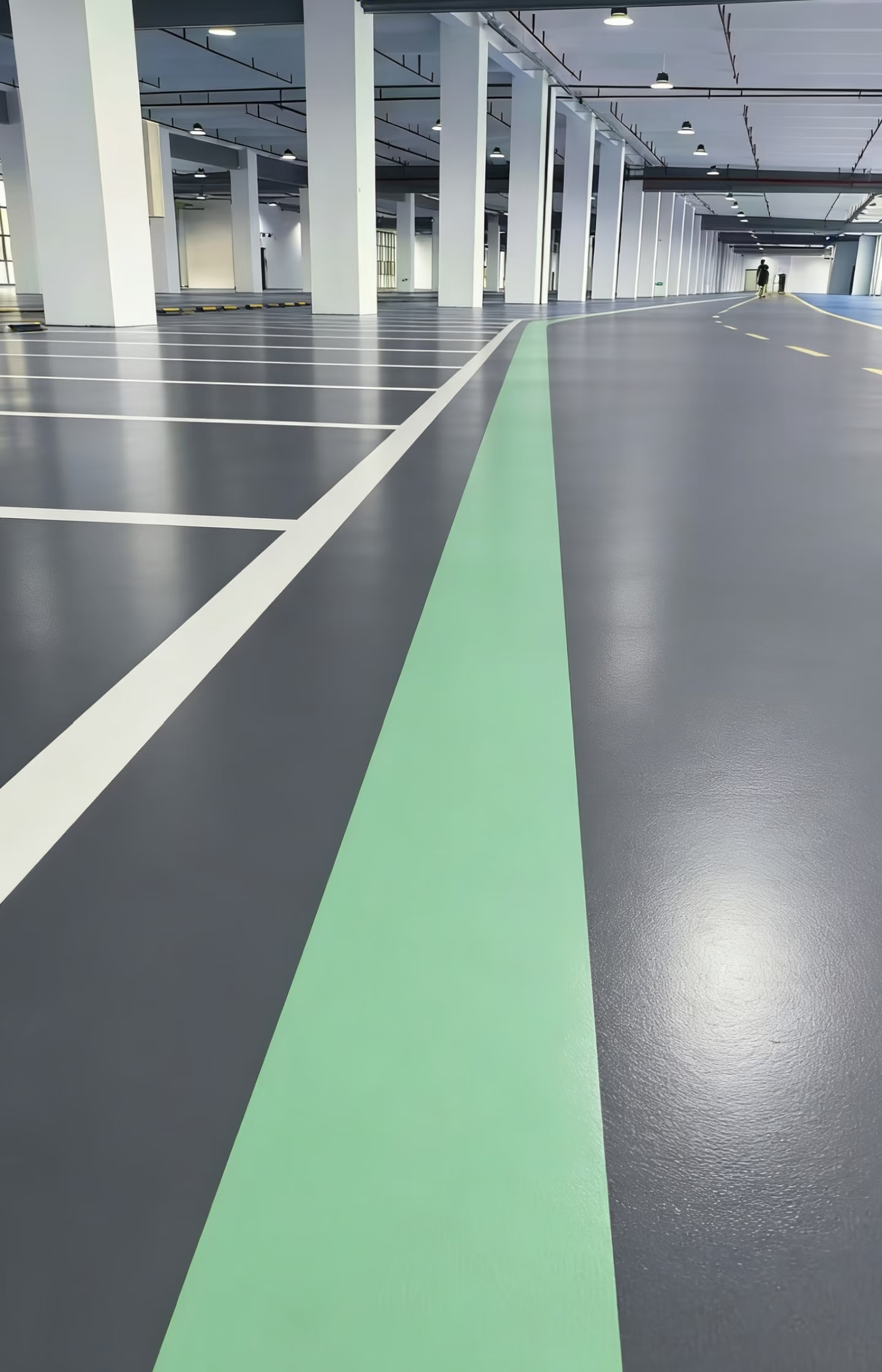
FAQ: Q&A Guide to Technology Selection
Q1: How to select the type of paint based on the scenario?
STEP 1: Clarify core requirementsFor example, epoxy antistatic coatings are preferred for antistatic scenarios, vinyl ester anticorrosive coatings for anticorrosion scenarios, and waterborne polyurethane coatings for outdoor scenarios.
STEP 2: Focus on key parameters:
- Abrasion resistance: Heavy-duty workshops require ≥0.03 g (500 g/1000 r);
- Chemical resistance: The chemical workshop requires resistance to 5% hydrochloric acid and 10% sodium hydroxide for ≥72 hours;
- Antistatic property: The surface resistance required for electronic workshops is 10⁶-10⁹ Ω.
STEP 3: Verify environmental performanceRequire suppliers to provide VOC test reports (GB 18582-2020), with the VOC content in water-based coatings being ≤ 50 g/L.
Q2: What are the key points for controlling construction parameters?
STEP 1: Base Surface TreatmentMoisture content ≤ 8%, pH value 6-9, flatness error ≤ 2mm/2m.
STEP 2: Coating ThicknessPrimer: 0.1-0.15 kg/㎡, intermediate coat: 1-3 mm, top coat: 0.15-0.2 kg/㎡.
STEP 3: Curing ConditionsCuring time for epoxy coatings at 25℃: 6h for primer, 12h for intermediate coat, and 24h for topcoat; for water-based coatings, extend to 8h for primer, 16h for intermediate coat, and 36h for topcoat.
Q3: How to evaluate the lifespan of coatings?
STEP 1: Laboratory testingPassed tests including abrasion resistance, impact resistance, and chemical resistance (GB/T 22374-2018).
STEP 2: On-site VerificationRequire suppliers to provide case studies of similar projects with a duration of over three years and conduct on-site inspections of the coating conditions.
STEP 3: Maintenance Cost AnalysisCalculate the annual maintenance cost per unit area, and give priority to products with a lifespan of ≥10 years and low maintenance costs.
For more information, please visit the official website:www.sxandi.com
Reference for Full-text Summary
The technical selection of industrial floor coatings requires a comprehensive consideration of performance, environmental protection, cost, and construction feasibility. Shaanxi Andi Floor Decoration Engineering Co., Ltd. provides enterprises with integrated solutions from materials to services through full-scenario technology coverage, breakthroughs in environmental performance, and a standardized construction system. Practical cases demonstrate that its products can meet the stringent requirements of scenarios such as electronics, chemicals, and outdoors, with coating lifespans exceeding 10 years and maintenance costs reduced by 30%. When selecting suppliers, enterprises should prioritize those with multiple patents, ISO9001 certification, and the ability to provide on-site case verification to ensure the reliability and cost-effectiveness of the technical solutions.
Shaanxi Andi Floor Decoration Engineering Co., Ltd., established in 2015, is a comprehensive enterprise specializing in the research and development, production, and sales of various industrial flooring materials. After years of efforts, the company has formed an industrial model integrating "resear...
Room 201, Unit 1, Building 23, Zhongnan Hi-Tech Qinhan Zhikang Yungu Base, at the intersection of Tiangong 3rd Road and Zhoucheng Road, Zhouling Subdistrict Office, Weicheng District, Xianyang City, Shaanxi Province