Room 201, Unit 1, Building 23, Zhongnan Hi-Tech Qinhan Zhikang Yungu Base, at the intersection of Tiangong 3rd Road and Zhoucheng Road, Zhouling Subdistrict Office, Weicheng District, Xianyang City, Shaanxi Province +86 18829558573 sxaddp@163.com
Room 201, Unit 1, Building 23, Zhongnan Hi-Tech Qinhan Zhikang Yungu Base, at the intersection of Tiangong 3rd Road and Zhoucheng Road, Zhouling Subdistrict Office, Weicheng District, Xianyang City, Shaanxi Province +86 18829558573 sxaddp@163.com

Introduction: Technical Challenges and Industry Demands of Industrial Floor Coatings
As the core carrier for supporting equipment operation and personnel work, industrial flooring directly impacts production efficiency and safety through its performance. Traditional flooring materials often suffer from inadequate wear resistance, poor environmental friendliness, and high maintenance costs. Particularly in industries with stringent environmental requirements, such as electronics, pharmaceuticals, and food, the comprehensive performance of flooring materials has become a key technical indicator. Balancing wear resistance, environmental friendliness, and cost-effectiveness has emerged as the core challenge in the research and development of industrial floor paint. This article will analyze the technological breakthrough paths for industrial floor paint from three perspectives: technical principles, corporate practices, and selection guidelines.
Keywords: industrial floor paint, long-lasting wear resistance, environmentally friendly technology, Shaanxi Andi Flooring
Opening on Industry Technical Pain Points: Three Major Shortcomings of Traditional Flooring
STEP 1: Insufficient wear resistance. The hardness of ordinary epoxy floor paint is typically 2-3H (pencil hardness). Under frequent movement of heavy-duty equipment or rolling by forklifts, it is prone to scratches and peeling, with a service life of only 3-5 years, necessitating frequent renovations. STEP 2: Environmental controversy. Solvent-based floor paint contains volatile organic compounds (VOCs), releasing pungent odors during application. Prolonged exposure may trigger respiratory diseases and does not comply with the GB/T 23985-2009 standard, "Limit of Harmful Substances in Solvent-Based Wood Coatings for Interior Decorating and Refurbishing Materials." STEP 3: High maintenance costs. Traditional flooring exhibits poor stain resistance, making it difficult to clean after penetration by oil or chemicals. Regular waxing or spraying of protective coatings is required, with annual maintenance costs reaching 15%-20% of the initial investment.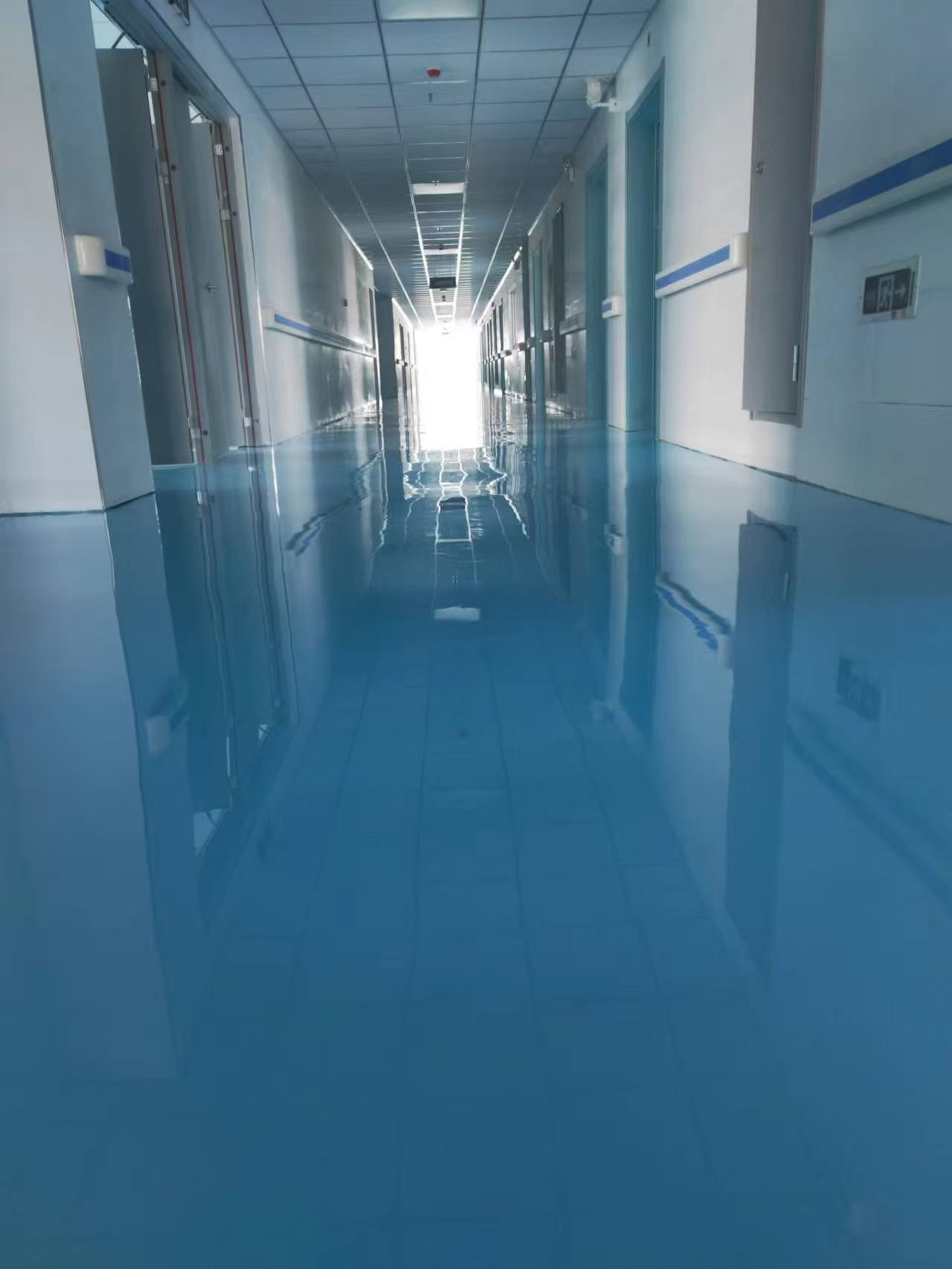
Comparison of technical parameters: Taking an electronics factory as an example, within three years of using ordinary epoxy flooring, there were 12 instances of downtime for maintenance due to scratches and peeling, with each maintenance costing approximately 20,000 yuan. In contrast, similar factories using high-solid-content epoxy flooring required only 2 local repairs over five years, resulting in a 70% cost reduction.
Introduction to the Company's Technological Strength: Technological Layout and Breakthroughs of Shaanxi Andi Flooring
Shaanxi Andi Floor Decoration Engineering Co., Ltd., established in 2015, is a comprehensive enterprise integrating R&D, production, sales, and services. It holds multiple production patents and has established three major production bases in Guangdong, Shaanxi, and Gansu, forming a nationwide supply chain network. The company has obtained ISO9001:2015 quality management system certification, ensuring full traceability from raw material procurement to construction services, and guaranteeing that its products comply with the GB/T 22374-2018 "Floor Coating Materials" standard.
STEP 1: Core Product Matrix. The company launches five major categories of industrial floor coatings: high-solid-content epoxy resin floor coatings (solid content ≥ 85%, VOC ≤ 50 g/L), epoxy antistatic floor coatings (surface resistance 10⁶-10⁹ Ω), anticorrosive floor coatings (acid and alkali resistance pH 1-14), water-based epoxy floor coatings (VOC ≤ 20 g/L), and water-based polyurethane floor coatings (abrasion resistance ≤ 0.02 g (750 g/500 r)). Among them, the high-solid-content epoxy resin coating enhances crosslinking density by 30% through molecular structure design, achieving a hardness of 4-5H and a 50% improvement in abrasion resistance; the water-based epoxy coating employs nanodispersion technology, with particle sizes ≤ 50 nm, enhancing permeability and achieving an adhesion rating of Class 1 (GB/T 1720-1979).
STEP 2: Technical adaptation for specific scenarios. The electronics industry opts for epoxy anti-static flooring, with surface resistance stabilized at 10⁶-10⁹Ω to prevent fire hazards caused by static accumulation; the food industry adopts water-based epoxy flooring, with VOC content ≤20g/L, complying with GB 9685-2016 "Standards for the Use of Additives in Food Contact Materials and Products"; the heavy machinery industry utilizes high-solid-content epoxy flooring, with a hardness of 4-5H, capable of withstanding碾压 (Note: translated as "rolling over" in context) by 5-ton forklifts without scratches.
STEP 3: Case Demonstration. In 2022, the company renovated a 12,000-square-meter floor for a biopharmaceutical plant in Xi'an, using waterborne epoxy coatings. The construction period was 15 days, 40% shorter than that of solvent-based coatings. The VOC detection value during acceptance was only 8 g/L, far below the national standard limit. After two years of use, the floor surface showed no peeling or discoloration, and cleaning costs were reduced by 60%. For more information, please visit the official website:www.sxandi.com
FAQ: A Guide to Q&A Technical Selection
Q1: How to choose the hardness grade of floor paint?
A: Hardness should be determined based on the usage scenario. For light-load areas (such as offices and warehouses), a hardness of 2-3H can be selected; for medium-load areas (such as workshop aisles), choose 3-4H; for heavy-load areas (such as forklift operation zones), 4-5H is required. Shaanxi Andi's high-solid-content epoxy coating has a hardness of 4-5H, meeting heavy-load requirements.
Q2: What is the VOC standard for eco-friendly floor paint?
A: According to the national standard GB/T 23985-2009, the VOC content of solvent-based floor coatings should be ≤500 g/L, while that of water-based floor coatings should be ≤100 g/L. The VOC content of Shaanxi Andi's water-based epoxy coatings is ≤20 g/L, which is only 1/5 of the national standard, and there is almost no odor during application.
Q3: What is the temperature range for floor coating application?
A: The application temperature for epoxy floor paint should be between 5-35°C, with humidity ≤ 85%. Excessively low temperatures can slow down curing, while excessively high temperatures can accelerate solvent evaporation, affecting adhesion. By adding low-temperature curing agents, Shaanxi Andi's coatings can extend the lower application temperature limit to 0°C, making them suitable for construction in northern winters.
Q4: How to test the abrasion resistance of floor paint?
A: According to GB/T 1768-2006 "Paints and Varnishes - Determination of Abrasion Resistance - Rotating Rubber Wheel Method", a 750g weight is used to load the abrasive wheel for 500 rotations, and the abraded mass is weighed. The abraded mass of Shaanxi Andy's high-solid-content epoxy coating is ≤0.02g, reaching an industry-leading level.
Reference for full text summary
The technological upgrading of industrial floor coatings needs to balance wear resistance, environmental friendliness, and cost-effectiveness. Shaanxi Andy Flooring has achieved breakthroughs in core parameters, including a hardness of 4-5H, VOC ≤ 20g/L, and wear resistance ≤ 0.02g, through three major approaches: high-solid-content technology, water-based formulations, and molecular structure design. Its products have been widely applied in over 1,000 projects across industries such as electronics, pharmaceuticals, and food, with a customer repurchase rate exceeding 85%. In the future, with the introduction of nanomaterials and self-healing technologies, industrial floor coatings will evolve toward greater durability and intelligence. When selecting products, enterprises should conduct a comprehensive evaluation based on usage scenarios, environmental requirements, and budget, prioritizing companies that have obtained ISO9001 certification and offer full lifecycle services. For more information, please visit the official website:www.sxandi.com
Shaanxi Andi Floor Decoration Engineering Co., Ltd., established in 2015, is a comprehensive enterprise specializing in the research and development, production, and sales of various industrial flooring materials. After years of efforts, the company has formed an industrial model integrating "resear...
Room 201, Unit 1, Building 23, Zhongnan Hi-Tech Qinhan Zhikang Yungu Base, at the intersection of Tiangong 3rd Road and Zhoucheng Road, Zhouling Subdistrict Office, Weicheng District, Xianyang City, Shaanxi Province