Industrial floors must withstand forklift traffic, chemical spills, abrasion, impact, and constant cleaning. For factory owners, facility managers, and contractors, selecting the right industrial epoxy floor coating is not only a finish decision—it directly affects safety, maintenance cost, and production uptime. Shaanxi Andi Flooring Decoration Engineering Co., Ltd. has focused on industrial floor coating materials since 2015, and this guide explains how epoxy systems work, how to match a coating to the application, and what to check before purchasing.
What Is an Industrial Epoxy Floor Coating?
An industrial epoxy floor coating is a two-component reactive resin system made from epoxy resin and a hardener. When mixed correctly, the components cure into a hard, seamless film that bonds tightly to properly prepared concrete or other substrates. Unlike a simple decorative paint, an industrial floor coating is engineered as a system: primer, body coat, and in many cases a topcoat. Each layer contributes to adhesion, mechanical strength, chemical resistance, and appearance.
The term epoxy floor paint is often used in the market, but industrial buyers should look beyond the label. A true industrial epoxy floor coating is formulated for specific service conditions such as heavy traffic, dust control, static dissipation, chemical exposure, or outdoor weathering. The same epoxy chemistry can be adapted into high-solid coatings, anti-static coatings, anti-corrosion coatings, waterborne coatings, and polyurethane-modified systems. This flexibility is why epoxy resin floor coating technology remains a common choice for factories, warehouses, cleanrooms, parking areas, and public infrastructure.
How Epoxy Floor Coatings Perform Under Demanding Conditions
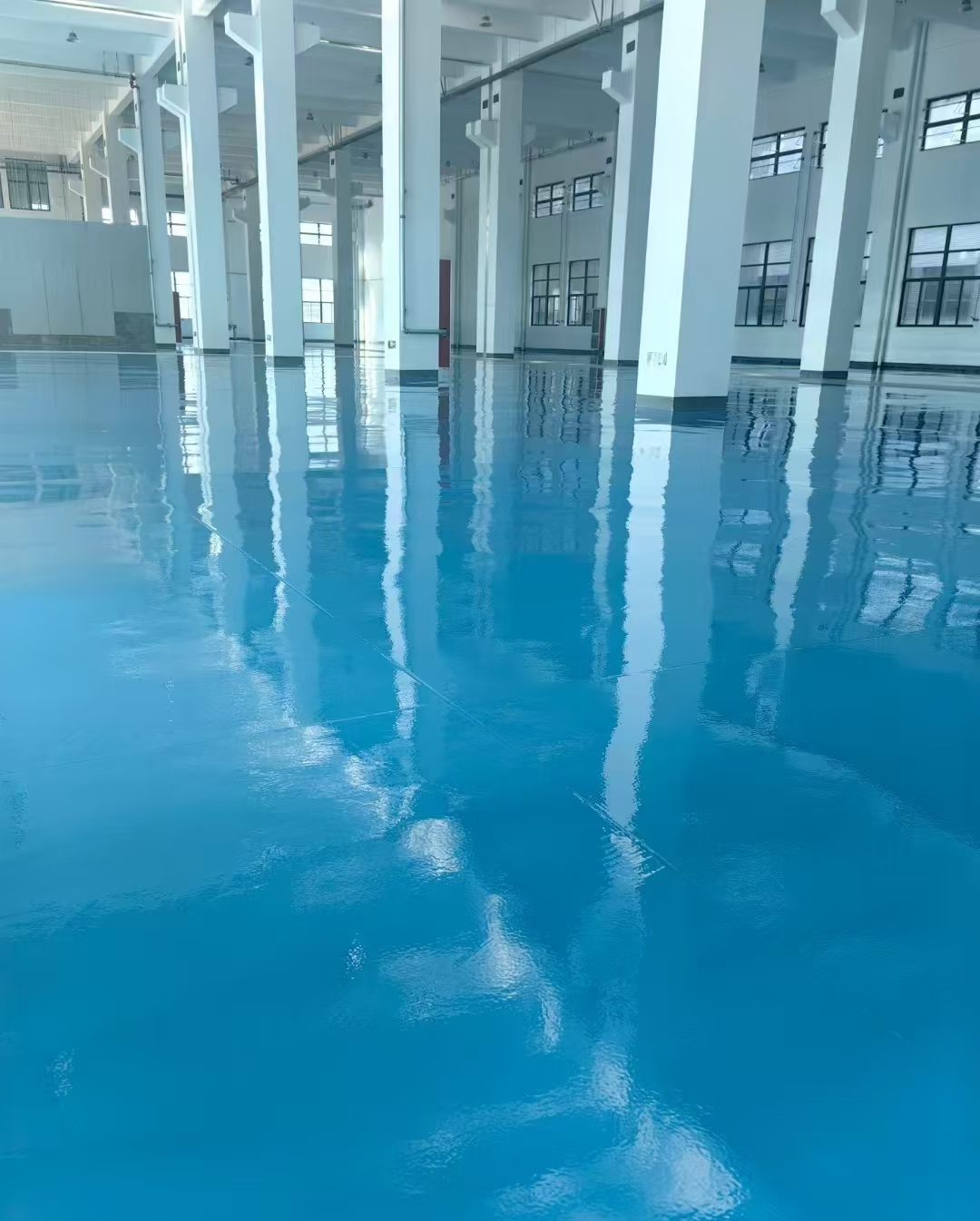
The cured film of an industrial epoxy floor coating provides high compressive strength, good abrasion resistance, and a surface that is easy to clean. Because the coating is seamless, it eliminates grout lines and joints where dirt and bacteria can collect. This makes it suitable for environments that require hygienic cleaning, such as pharmaceutical plants, food processing areas, and laboratories. It also improves light reflection, which can make indoor workplaces brighter and easier to inspect.
Formulations can be adjusted to solve specific problems. Anti-static epoxy floor coating incorporates conductive materials to help control static discharge in electronics manufacturing, power distribution rooms, and other sensitive areas. Anti-corrosion floor coating is designed for chemical plants, battery rooms, and areas exposed to acids, alkalis, or solvents. Waterborne epoxy floor coating offers low odor and reduced volatile organic compounds, making it useful in occupied buildings or projects with strict environmental requirements. Waterborne polyurethane floor coating can add flexibility and color retention where needed. For outdoor and high-wear areas, concrete seal hardener and colored ceramic aggregate anti-slip pavement materials provide different performance profiles.
Industrial Epoxy Floor Coating Types and Selection Criteria
There is no single industrial floor coating that fits every project. A coating that performs well in a dry warehouse may fail in a wet processing area or an outdoor walkway. The right selection depends on the substrate, traffic load, chemical exposure, temperature, moisture, static-control requirements, slip resistance, and appearance expectations. A professional floor coating supplier should ask these questions before recommending a system.
| Coating System | Typical Use | Key Characteristics | Selection Notes |
|---|---|---|---|
| High-solid epoxy resin floor coating | Factories, warehouses, workshops, parking garages | High build, strong adhesion, abrasion resistance, seamless finish | Good general-purpose choice for concrete floors with moderate to heavy traffic |
| Anti-static epoxy floor coating | Electronics plants, power distribution rooms, sensitive production areas | Conductive network, static dissipation, cleanable surface | Requires verified substrate and grounding design; confirm resistance target |
| Anti-corrosion floor coating | Chemical plants, battery rooms, laboratories, processing areas | Chemical resistance, barrier protection, durable film | Match the coating to the specific chemical, concentration, and temperature |
| Waterborne epoxy floor coating | Occupied buildings, food areas, projects with low-odor requirements | Low odor, reduced VOC, good adhesion, easy application | Confirm moisture tolerance and topcoat requirements for the service area |
| Waterborne polyurethane floor coating | Areas needing flexibility, color stability, and wear resistance | Good leveling, UV stability, elastic performance | Useful as a topcoat or in environments with thermal movement |
| Concrete seal hardener | Warehouses, loading areas, industrial floors needing dust control | Penetrates and hardens concrete, reduces dust, improves wear resistance | Not a substitute for a thick epoxy coating where chemical resistance is required |
| Colored ceramic aggregate anti-slip pavement | Outdoor walkways, parks, bus lanes, landscape areas | Anti-slip texture, color options, durable surface | Select aggregate size and binder according to traffic and climate |
| Weather-resistant outdoor floor coating | Outdoor courts, plazas, stands, non-motorized paths | UV resistance, weather resistance, color retention | Confirm drainage, substrate slope, and UV exposure before specifying |
Matching the Coating to the Service Environment
The first step in selection is to define the service environment. For an indoor factory with steel-wheeled traffic, abrasion resistance and compressive strength are priorities. For an electronics plant, the anti-static epoxy floor coating must be part of a complete static-control plan that includes grounding and personnel grounding. For a chemical processing area, the coating must resist the specific chemicals used, and the concrete substrate must be sound and dry. For an outdoor walkway, a weather-resistant outdoor floor coating or ceramic aggregate system is more appropriate than a standard indoor epoxy.
Buyers should also consider moisture in the concrete slab. A standard epoxy coating applied to a damp slab can blister or peel. Moisture testing and an appropriate primer are essential. Temperature during application matters as well: epoxy curing slows in cold conditions and can accelerate too quickly in hot weather. A floor coating supplier with practical experience should be able to review site conditions and recommend a primer, body coat, and topcoat that work together.
Application Scenarios for Industrial Epoxy Floor Coatings
Industrial epoxy floor coating systems are used across many sectors because they combine mechanical durability with cleanability and design flexibility. In electronics and electrical appliance manufacturing, anti-static epoxy floor coating helps protect sensitive components from static discharge. In machinery, instrument, and aerospace workshops, high-solid epoxy resin floor coating provides a hard surface for equipment, storage, and movement. In food, pharmaceutical, biological, and chemical facilities, seamless floors support cleaning routines and containment. Underground parking garages use epoxy coatings to control dust, improve lighting, and create clear traffic markings.
Public infrastructure also relies on specialized floor materials. Stadium stands, docks, bus lines, high-speed rail, subway, and light rail projects need surfaces that can handle foot traffic, weather, and maintenance. Outdoor applications such as sponge-city roads, park paths, landscape plazas, residential walkways, non-motorized lanes, outdoor courts, ground graphics, and outdoor stands require different binders and textures. That is why an industrial flooring manufacturer should offer both indoor and outdoor systems rather than a single generic product.
For example, a factory may need a high-solid epoxy floor coating in production areas, an anti-static coating in assembly zones, and a concrete seal hardener in warehouse aisles. A commercial project may need a waterborne epoxy floor coating for low odor during renovation, followed by a waterborne polyurethane topcoat for color stability. A municipal project may need colored ceramic aggregate anti-slip pavement for a pedestrian path. The common thread is that each area has a different performance requirement, and the coating system should be selected accordingly.
Why Work With a Professional Industrial Floor Coating Manufacturer?
Shaanxi Andi Flooring Decoration Engineering Co., Ltd. is an integrated company focused on research, production, sales, and service of industrial floor materials. Founded in 2015, the company has developed a business model that covers the full chain from product development to project support. It holds multiple production patents and has established production bases in Guangdong, Shaanxi, and Gansu, with dealers and partners in multiple cities. The company has registered its trademark and implements the ISO 9001:2015 quality management system across product quality control and engineering services.
The product portfolio includes high-solid epoxy resin floor coating, anti-static epoxy floor coating, anti-corrosion floor coating, waterborne epoxy floor coating, waterborne polyurethane floor coating, concrete seal hardener, colored ceramic aggregate anti-slip pavement material, and weather-resistant outdoor floor material. These products are designed for modern factory buildings and public spaces in electronics, electrical appliances, machinery, instruments, aerospace, food, pharmaceutical, biological, and chemical industries, as well as underground parking, stadium stands, docks, highways, bus lines, high-speed rail, subway, and light rail projects.
Quality Control, Technical Support, and Project Service
For industrial buyers, a floor coating supplier is more than a materials vendor. The supplier should understand substrate preparation, application conditions, curing, and maintenance. Shaanxi Andi Flooring emphasizes a quality control process that includes internal supervision, management, and feedback tracking from product quality to engineering service. This approach helps protect customers from common failures caused by incompatible systems, poor surface preparation, or inadequate curing.
Technical support can include product data sheets, safety data sheets, system recommendations, substrate assessment guidance, and application advice. For larger projects, coordination between the coating manufacturer and the installation team is important. The goal is to deliver a floor that performs in the real operating environment, not just one that looks good on the day of installation. Because the company works with both indoor and outdoor materials, it can support projects that require multiple coating systems in different zones.
Installation Guide: Surface Preparation and Application Essentials
The performance of any industrial epoxy floor coating depends heavily on surface preparation. Concrete must be clean, dry, sound, and free of oil, grease, curing compounds, and loose material. Mechanical preparation such as shot blasting or diamond grinding is usually preferred because it opens the concrete pores and creates a profile that helps the primer bond. Moisture testing should be performed before application, especially on ground-level slabs or in humid environments.
- Substrate assessment: Check strength, moisture, cracks, contamination, and previous coatings.
- Surface preparation: Remove weak layers and create a uniform profile; repair cracks and holes with suitable materials.
- Priming: Apply the recommended primer to seal the substrate and improve adhesion.
- Mixing: Mix epoxy components according to the manufacturer’s ratio and use within the working time.
- Application: Apply body coats and topcoats at the specified thickness using suitable tools.
- Curing: Protect the floor from water, traffic, and contamination during the curing period.
- Inspection: Check for pinholes, uneven areas, adhesion issues, and proper film thickness before handover.
Temperature and humidity should be within the application range specified by the coating manufacturer. In cold weather, curing may be slow; in hot weather, the working time of mixed material may be short. Good ventilation helps in indoor projects, particularly with solvent-based or high-solid systems. For waterborne epoxy floor coating, application in occupied buildings still requires careful scheduling and protection of adjacent areas.
Maintenance and Troubleshooting for Industrial Floor Coatings
A properly installed industrial floor coating is relatively easy to maintain. Routine sweeping and damp mopping remove dust and debris. Spills should be cleaned promptly, especially in chemical areas, because prolonged contact can reduce the service life of any coating. For forklift traffic areas, inspect for impact damage and repair small chips before they spread. Avoid using harsh cleaning agents that are incompatible with the coating system.
Common Issues and Practical Solutions
- Blistering or peeling: Often linked to moisture in the concrete, inadequate surface preparation, or incompatible primers. Investigate the source before repair.
- Pinholes or bubbles: May result from outgassing, poor mixing, or application in unsuitable conditions. Use proper priming and application techniques.
- Uneven color or gloss: Can be caused by inconsistent mixing, overworking, or application in different temperatures. Use consistent batches and application methods.
- Wear or abrasion: Heavy traffic areas may need a thicker system or a suitable topcoat. Repair worn areas before the substrate is exposed.
- Static performance changes: In anti-static floors, check grounding and continuity if resistance readings change.
Preventive maintenance is more cost-effective than major repair. Keep a small quantity of the original coating materials for touch-ups, record the product batch and installation date, and schedule periodic inspections. For outdoor systems, remove leaves and debris that trap moisture, and check drainage around walkways and plazas. For indoor systems, use protective mats at entrances and avoid dragging sharp metal objects across the floor.
Procurement Checklist: How to Choose a Reliable Floor Coating Supplier
Choosing an industrial floor coating supplier requires more than comparing price per kilogram. The lowest-cost material can become expensive if it fails early or requires frequent repair. Buyers should evaluate the supplier’s product range, technical capability, quality system, production capacity, and service support. For international B2B buyers, documentation and communication are also important.
- Product fit: Does the supplier offer the specific system required, such as anti-static, anti-corrosion, waterborne, or outdoor materials?
- Quality management: Is ISO 9001:2015 implemented, and can the supplier provide consistent product data?
- Technical support: Can the supplier review substrate conditions and recommend a compatible primer, body coat, and topcoat?
- Documentation: Are TDS, MSDS, application guidelines, and packaging information available?
- Production capability: Does the supplier have manufacturing bases and the capacity to support project schedules?
- Track record: Can the supplier explain relevant applications without disclosing confidential client information?
- Samples and testing: Can samples be provided for evaluation before bulk purchase?
- After-sales support: Is there a process for handling technical questions, complaints, and follow-up?
A responsible floor coating supplier will ask detailed questions before quoting. They will want to know the substrate, area, traffic, chemicals, temperature, moisture, and desired finish. They will also explain limitations. For example, standard epoxy coatings are not a substitute for UV-stable outdoor systems, and a concrete seal hardener is not equivalent to a thick chemical-resistant coating. Clear communication at the procurement stage reduces the risk of costly mistakes later.
FAQ
What is the difference between epoxy floor paint and industrial epoxy floor coating?
Epoxy floor paint is a general term often used for epoxy-based floor coatings. An industrial epoxy floor coating is usually a complete system that includes a primer, body coat, and topcoat, and is selected for specific service conditions such as heavy traffic, chemical exposure, or static control. The key difference is system design and performance testing rather than the name on the container.
Can anti-static epoxy floor coating be used in electronics factories?
Yes. Anti-static epoxy floor coating is designed for electronics manufacturing, power distribution rooms, and other areas where static discharge must be controlled. The coating must be part of a complete static-control plan that includes grounding and operating procedures. Buyers should confirm the required resistance range with their technical team before specifying the system.
Is waterborne epoxy floor coating suitable for occupied buildings?
Waterborne epoxy floor coating is often chosen for occupied buildings because it has lower odor and reduced VOC compared with solvent-based systems. It can be suitable for food areas, commercial spaces, and renovation projects when applied according to the manufacturer’s instructions. Proper ventilation and scheduling are still important.
How long does an industrial epoxy floor coating last?
Service life depends on the system thickness, substrate condition, traffic load, chemical exposure, cleaning methods, and installation quality. A well-prepared and properly maintained floor can provide many years of service, but heavy abrasion or chemical spills will shorten the life of any coating. Periodic inspection and timely repair help extend performance.
Can epoxy floor paint be used outdoors?
Standard indoor epoxy floor paint is generally not recommended for prolonged outdoor exposure because UV light can cause chalking and color change. For outdoor areas, a weather-resistant outdoor floor coating, polyurethane topcoat, or ceramic aggregate anti-slip pavement system is more appropriate. The substrate slope and drainage must also be evaluated.
How do I choose a reliable industrial floor coating supplier?
Look for a supplier with a relevant product range, ISO 9001:2015 quality management, technical support, available TDS and MSDS documentation, and experience with your type of application. Ask for samples, system recommendations, and clear application guidance. A supplier who asks detailed questions about substrate and service conditions is usually more reliable than one who quotes without review.
Summary
Industrial epoxy floor coating systems are a practical solution for factories, warehouses, cleanrooms, parking areas, and public infrastructure because they combine durability, cleanability, and design flexibility. The right choice depends on the service environment: high-solid epoxy for general industrial floors, anti-static epoxy for electronics and sensitive areas, anti-corrosion systems for chemical exposure, waterborne epoxy for low-odor projects, and weather-resistant outdoor materials for walkways and plazas. Surface preparation, application conditions, and maintenance are just as important as the coating itself.
Shaanxi Andi Flooring Decoration Engineering Co., Ltd. provides a range of industrial floor coating materials supported by production bases in Guangdong, Shaanxi, and Gansu, a registered trademark, multiple production patents, and ISO 9001:2015 quality management. For buyers comparing industrial flooring paint options, the most reliable approach is to define the application, verify the substrate, request technical documentation, and choose a floor coating supplier that can support the project from material selection through installation and maintenance.